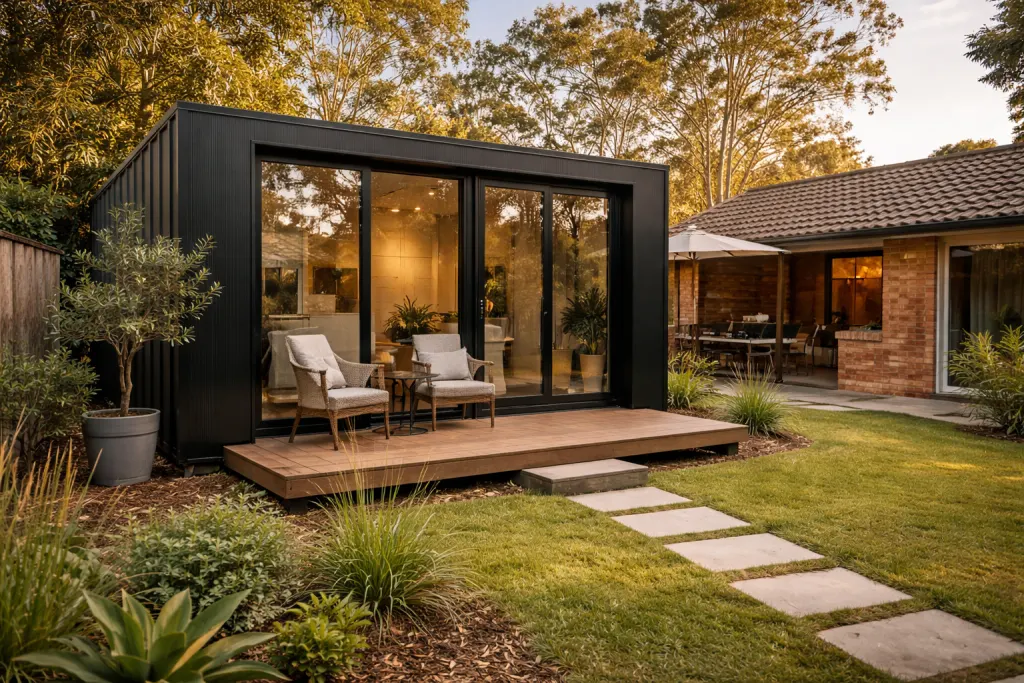
Bunnings is now selling flat-pack tiny home studios you can assemble in your backyard over a weekend. The hardware giant has partnered with Melbourne startup Elsewhere Pods to offer two DIY pod sizes through its stores — and the entry price is $26,100.
It’s a significant moment for the tiny home movement in Australia. When the country’s biggest hardware retailer starts stocking tiny homes alongside the barbecues and power tools, it signals that small-footprint living has gone thoroughly mainstream.
What’s on Offer
Two models are available through Bunnings:
| Model | Size | Floor Area | Price |
|---|---|---|---|
| Small studio | 2.7m x 2.4m | ~6.5 sqm | $26,100 |
| Large studio | 4m x 2.4m | ~9.6 sqm | $42,900 |
Both pods feature double-glazed windows, high-level soundproofing, and a modern black exterior. They’re designed to be assembled by a competent DIYer — Elsewhere Pods founder Matt Decarne describes it as a step above assembling IKEA furniture. The only professional you’ll need is a qualified electrician.
What It Is — and What It Isn’t
Let’s be clear about what these pods are and aren’t:
What they are:
- A backyard studio, home office, extra bedroom, art studio, or hobby space
- Under 10 sqm, so they generally don’t require a building permit in most council areas
- A genuine flat-pack product you can assemble yourself
- A well-designed, architecturally modern structure
What they aren’t:
- A self-contained dwelling — they don’t include a kitchen, bathroom, or plumbing
- A replacement for a granny flat or secondary dwelling — those need to be self-contained and council-approved
- A tiny home on wheels — these are fixed structures
- Large enough to live in full-time as a primary residence
If you’re looking for a complete, self-contained tiny home to live in, these aren’t it. But as a way to add functional space to your property without a DA, they fill a genuine gap.
The Bigger Picture: Why This Matters
The Bunnings deal is interesting not because of the pods themselves, but because of what it signals about the market.
Mainstream acceptance. When Bunnings COO Ryan Baker talks about tiny homes and outdoor rooms as a growing product category, that’s a cultural shift. Five years ago, tiny homes were a niche interest. Now they’re sitting in the same retail ecosystem as deck screws and Weber grills.
Affordability driving demand. Australian Tiny House Association president Danielle Lester puts it plainly: the growth in tiny homes is driven by necessity, not novelty. For single-income households, older women, regional workers, and first-home buyers, tiny homes represent one of the few remaining ways to secure housing without unsustainable debt.
Competition is heating up. Bunnings isn’t the only big player moving into this space. Amazon Australia already offers foldable tiny houses from around $11,300, and the broader modular and prefabricated home market is growing rapidly — the Commonwealth Bank became the first Big Four lender to finance modular homes in January 2025.
Elsewhere Pods: The Story Behind the Product
Elsewhere Pods founder Matt Decarne was formerly an international trade law consultant. His side project became a full-time business when his mother lost her home in the 2020 Northern NSW floods. Within eight weeks, he had built her a tiny home pod while communities rebuilt.
Before the Bunnings partnership, 40 per cent of Elsewhere Pods’ sales were for Airbnb investors looking to generate income from regional properties. The large glass panels suit tree-lined or isolated areas where guests pay to stay and disconnect. The rest of their customers buy pre-assembled pods (starting at $58,000 for larger models) for backyard offices, studios, and extra bedrooms.
The DIY range sold through Bunnings is a standardised subset of their broader designs, simplified for self-assembly.
How It Compares to Other Options
If you’re exploring small-footprint options for your property, here’s how the Bunnings pods sit in the broader landscape:
| Option | Size | Cost | Self-contained? | Council approval? |
|---|---|---|---|---|
| Bunnings/Elsewhere Pod | 6.5–9.6 sqm | $26k–$43k | No | Generally not required |
| Flat-pack tiny home kit | 15–50 sqm | $45k–$120k (kit) | Yes | Yes (DA or CDC) |
| THOW from a builder | 15–30 sqm | $80k–$160k | Yes | Varies by council |
| Granny flat | 30–60 sqm | $100k–$200k+ | Yes | Yes (CDC or DA) |
The Bunnings pods are the cheapest and simplest option, but they’re not a dwelling. If you need somewhere to live, you’ll need a self-contained home with kitchen and bathroom — which means stepping up to one of the other options and navigating your council’s approval process.
Should You Buy One?
Yes, if you want a backyard studio, office, or extra room and you’re comfortable with basic DIY. At $26,100 for the smaller model, it’s cheaper than most renovations and you’ll have it up in days rather than months.
Not yet, if you’re looking for somewhere to actually live. These pods are a great addition to a property, but they’re not a self-contained dwelling. For that, explore our types of tiny homes guide and builder directory to find something that includes a kitchen, bathroom, and everything else you need for daily living.
Worth watching if you’re interested in how the market is evolving. The fact that Bunnings is in this space suggests more products, larger sizes, and potentially self-contained options are coming. The demand is clearly there.
Frequently Asked Questions
Do I need council approval for a Bunnings tiny home pod?
Generally no — both models are under 10 sqm, which falls under exempt development in most council areas. However, rules vary by council, and factors like heritage overlays, bushfire-prone land, or flood zones can change the requirements. Check with your local council before purchasing. Our regulation guides explain the approval pathways in each state.
Can I live in a Bunnings pod?
Not as a self-contained dwelling — the pods don’t include a kitchen, bathroom, or plumbing. They’re designed as studios, offices, and extra rooms. If you want a tiny home you can live in, look at self-contained options from Australian builders or explore the different types of tiny homes available.
How long does it take to assemble?
Elsewhere Pods says assembly can be completed in as little as two days for the smaller model. Realistically, budget a weekend for someone experienced with tools. You’ll need a qualified electrician for the electrical fit-out.
Is this the cheapest tiny home in Australia?
At $26,100, it’s one of the cheapest pre-engineered structures you can buy, but it’s not a complete home. The cheapest self-contained tiny home options are DIY builds ($40,000–$60,000 in materials) or flat-pack kits ($45,000–$120,000). See our full cost guide for a realistic breakdown.