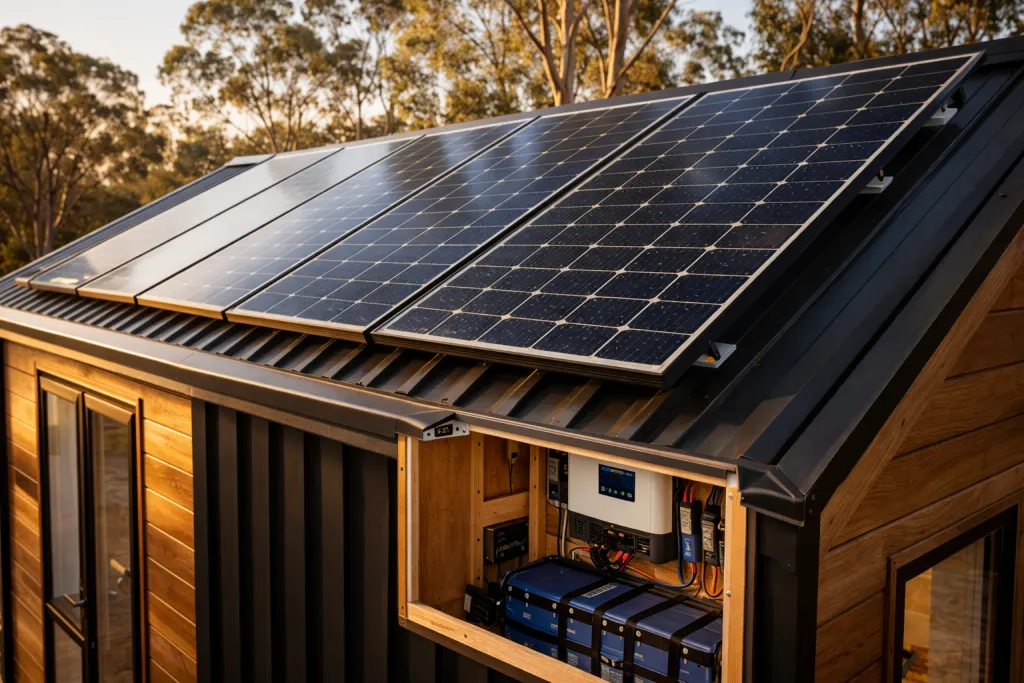
Going off-grid is one of the most appealing aspects of tiny home living. No electricity bills, no reliance on the grid, and a genuinely lower carbon footprint. For a broader look at what self-sufficient living involves beyond just power, see our guide to off-grid tiny home living. But designing a solar system that actually works — day in, day out, through an Australian winter — takes some planning.
Start With Your Energy Usage
Before you spec a single panel, you need to know how much power you’ll use. A typical tiny home in Australia consumes between 3 and 8 kilowatt-hours (kWh) per day, depending on your setup.
Here’s a rough daily breakdown for a modest off-grid tiny home:
| Appliance | Estimated Daily Use |
|---|---|
| LED lighting | 0.3 kWh |
| Laptop and phone charging | 0.4 kWh |
| Fridge (efficient 12V or 240V inverter model) | 1.0 – 1.5 kWh |
| Water pump | 0.2 kWh |
| Washing machine (every second day) | 0.5 kWh |
| Induction cooktop (if electric) | 1.0 – 2.0 kWh |
| Miscellaneous (fans, router, small appliances) | 0.3 kWh |
Total: roughly 4 – 6 kWh per day for a well-managed tiny home. If you’re running air conditioning, an electric hot water system, or power tools regularly, that figure climbs.
Sizing Your Solar Array
Australia gets excellent solar irradiance — between 4 and 6 peak sun hours per day depending on your location. Darwin and outback Queensland sit at the top end; Tasmania and southern Victoria see fewer hours, especially in winter.
A common starting point for a tiny home is a 2 kW to 3 kW solar array — that’s roughly 5 to 8 panels rated at 400W each. This provides enough generation in most parts of Australia to cover 5–7 kWh of daily use, with some margin.
Roof-Mounted vs Ground-Mounted
Tiny homes on wheels have limited roof space, which can restrict how many panels you fit. Options include:
- Roof-mounted panels — convenient but limited to 2–4 panels on most builds
- Ground-mounted or portable panels — more flexible, can be angled optimally, and moved with the seasons
- A combination — roof panels for base load, with portable panels adding capacity when needed
Battery Storage
Batteries are the most expensive part of an off-grid system, and getting the sizing right matters. Lithium iron phosphate (LiFePO4) batteries are the standard for off-grid tiny homes due to their long cycle life, safety profile, and depth of discharge.
For a 5 kWh daily usage, you’ll want at least 10 kWh of usable battery capacity — enough for about two days of autonomy during cloudy weather. Popular options in Australia include:
- Enphase IQ Battery 5P — modular, scalable, well-supported locally
- BYD Battery-Box Premium — widely available through Australian solar installers
- SimpliPhi or DIY LiFePO4 banks — popular with hands-on builders
Budget roughly $5,000 – $12,000 for a quality battery bank, depending on capacity and brand.
Inverters and Charge Controllers
You’ll need two key components connecting your panels to your batteries and appliances:
- A solar charge controller — MPPT (Maximum Power Point Tracking) controllers are more efficient than PWM and worth the extra cost. Victron and EPEver are popular brands in the Australian market.
- An inverter/charger — converts 12V or 48V battery power to 240V AC for standard appliances. Look for pure sine wave inverters rated for Australian voltage. Victron MultiPlus and Selectronic are well-regarded.
What Will It Cost?
A complete off-grid solar setup for a tiny home in Australia typically runs between $8,000 and $25,000, depending on system size and component quality.
| Component | Estimated Cost |
|---|---|
| Solar panels (2–3 kW) | $1,500 – $3,000 |
| Battery bank (10 kWh) | $5,000 – $12,000 |
| Inverter/charger | $1,500 – $4,000 |
| Charge controller | $300 – $800 |
| Wiring, mounting, and BOS | $500 – $2,000 |
| Installation (if not DIY) | $1,000 – $3,000 |
A Few Practical Tips
- Cook with gas if you can — LPG cooktops and ovens dramatically reduce your electricity needs.
- Use a gas or solar hot water system rather than electric. A roof-mounted evacuated tube system works well even in cooler climates like the Blue Mountains or Gippsland.
- Monitor your system — a battery monitor like the Victron SmartShunt gives you real-time insight into your energy balance.
- Plan for winter — size your system for your worst month, not your best. In southern Australia, winter generation can be half of what you get in summer.
Going off-grid isn’t just about the gear — it’s about understanding your energy habits and designing a system that matches them. Get that right, and solar can comfortably power your tiny home year-round. If you are looking for a builder with off-grid experience, our builder directory can help you find one.