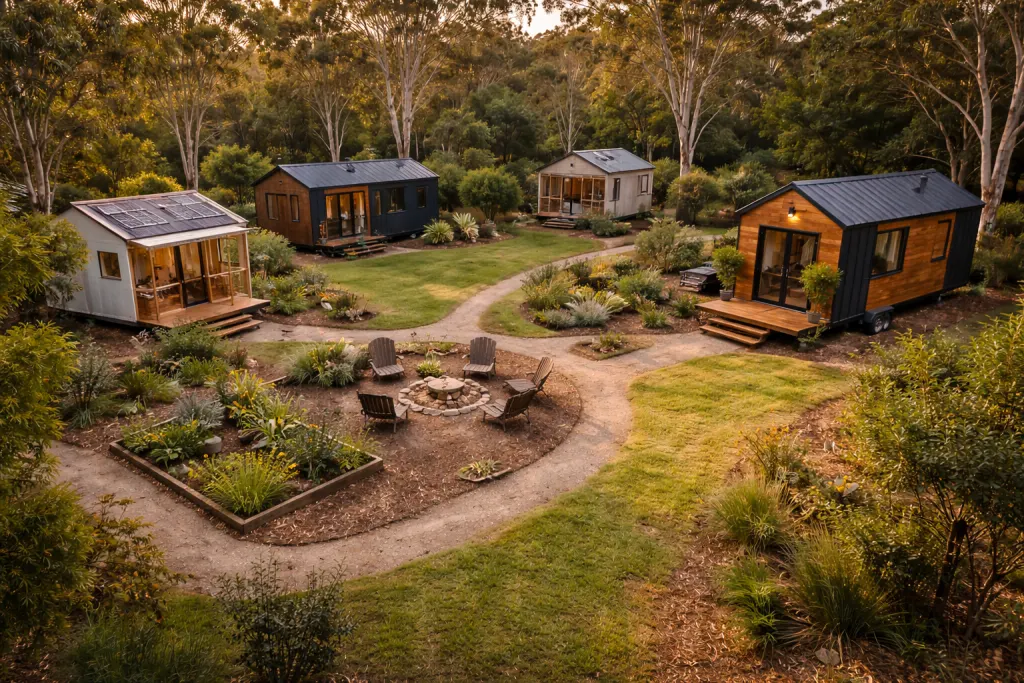
One of the most common questions from aspiring tiny home owners is simple but surprisingly tricky: where do I actually put it? If you don’t own rural land or have a family member with a spare paddock, a tiny home community might be the answer.
What Is a Tiny Home Community?
A tiny home community — sometimes called a tiny home village or eco-village — is a planned development where multiple tiny homes share a common site. Residents typically lease or licence a pad (a prepared space for their home), and share communal facilities like laundries, gardens, workshops, or social spaces.
The models vary. Some communities are structured as residential parks under state legislation. Others operate as intentional communities or cooperatives with shared governance. A few are privately owned and run more like boutique caravan parks with a focus on permanent, quality dwellings.
Where to Find Them
New South Wales
- Tiny Houses Lismore — one of the earlier community-style developments in the Northern Rivers region, offering pads for tiny homes on wheels with shared amenities.
- The Village Byron — a purpose-built community near Byron Bay combining tiny homes, shared gardens, and co-working spaces. Pad leases are available with varying terms.
- Various Northern Rivers sites — the post-flood recovery in the region has accelerated interest in tiny and relocatable housing, and several new community projects are in development.
Queensland
- Tiny Away — while primarily a tiny home accommodation business, Tiny Away partners with landowners across southeast Queensland and beyond to host tiny homes on rural and semi-rural properties.
- Eco-villages on the Sunshine Coast — communities like Narara Ecovillage (Central Coast, NSW) have inspired similar projects in the Hinterland, focused on sustainability and shared living.
- Scenic Rim and Lockyer Valley — rural communities in these areas have been more receptive to tiny home development, partly due to lower land costs and council willingness to explore alternative housing.
Victoria
- Tiny Footprint Co-op — a cooperative housing model in regional Victoria exploring shared land ownership and tiny home pads for members.
- Gippsland and the Yarra Valley — several private landowners have begun offering long-term tiny home sites, often through informal arrangements. These work well but carry risks if not formalised with proper lease agreements.
South Australia and Tasmania
Both states are seeing growing interest. In Tasmania, the combination of affordable rural land and a strong sustainability culture has made the state a natural fit for tiny home communities. The Huon Valley and Tasman Peninsula have both seen community projects at various stages of development.
In South Australia, peri-urban areas around Adelaide and the Adelaide Hills are emerging as locations for small-dwelling-friendly developments.
What to Look for in a Community
Not all communities are created equal. Before committing, consider:
- Legal structure — is it a residential park, a cooperative, a lease arrangement, or something informal? Your rights and protections differ significantly depending on the model. Our leasing and land-sharing guide explains the key differences, and you should understand the regulations in your state before signing anything.
- Tenure security — how long is your agreement, and what happens if the landowner sells or the community changes direction?
- Costs — site fees typically range from $150 to $350 per week, depending on location and inclusions. Some communities also charge a one-off establishment fee.
- Rules and standards — most communities have guidelines about dwelling size, aesthetics, noise, pets, and guests. Make sure these align with how you want to live.
- Services — what’s provided on-site? Water, power, internet, waste disposal? Are these included in the site fee or charged separately?
Building Community Takes Time
Living in a tiny home community isn’t just about having a place to park your home. It’s a social decision. You’re choosing neighbours, shared spaces, and in many cases, a degree of collective responsibility. The communities that work best tend to have clear expectations, transparent governance, and a genuine sense of shared purpose.
If the idea appeals to you — whether you are a retiree downsizing to a simpler life or simply seeking a more connected way of living — start by visiting a few communities in person. Talk to current residents — not just the operators — and ask about the day-to-day reality. The lifestyle can be deeply rewarding, but it helps to go in with open eyes.
Getting Started
We maintain a growing list of tiny home communities and sites across Australia. If you are looking for a builder to create your tiny home, check out our builder directory. And if you know of a community we’ve missed, get in touch — we’d love to include it.