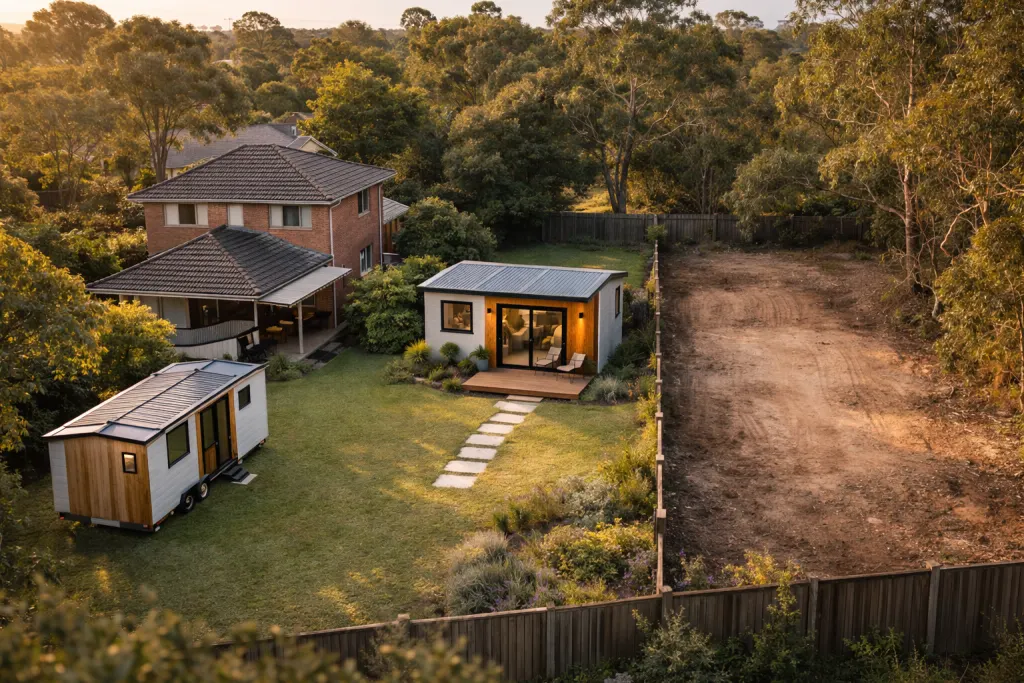
The short answer: yes, in most cases — but the rules depend on your state, your council, the type of tiny home, and how you plan to use it. This is the single most-asked question in Australian tiny home living, and the answer is more nuanced than most people expect.
There are three main scenarios, and each follows different rules:
- Putting a tiny home on wheels (THOW) on your property
- Building a secondary dwelling (granny flat) on your property
- Building a tiny home as your primary residence
Scenario 1: Tiny Home on Wheels on Your Property
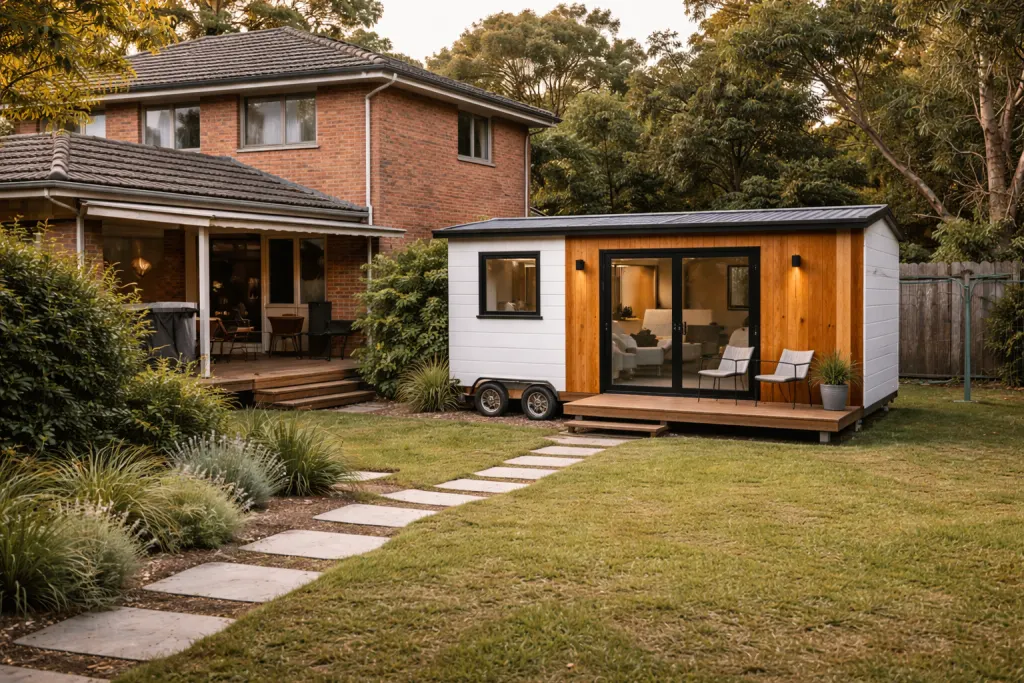
If your tiny home is on a registered trailer, the rules vary significantly by state.
NSW — Clause 77 exemption
NSW has the clearest pathway. Under Clause 77 of the Local Government Regulation 2021, you do not need council approval for one caravan (including a THOW) on your land if:
- There is an existing dwelling on the property
- The caravan is occupied only by the owner or a member of the owner’s household
- There is only one caravan on the land
This allows long-term, permanent occupation — not just short stays. A separate exemption allows up to two caravans for a maximum of 60 days per year.
The grey area: There is no explicit law that prohibits or permits charging rent under this exemption. Contributions toward utilities are common, but full commercial rental is legally unclear.
Queensland — Council by council
Queensland has no statewide exemption like NSW’s Clause 77. Each council sets its own rules through local laws. Time limits for caravan occupation without a permit range from 2 weeks (Gold Coast) to 4 weeks (Sunshine Coast) per year. Gold Coast and Cairns are generally considered the most accommodating councils for permanent THOW living. Contact your council directly and get their position in writing.
Victoria — 28 days typical, Surf Coast exception
Under the Residential Tenancies Act, a THOW is classified as a caravan. Most VIC councils allow occupation for up to 28 days without a permit. The notable exception is the Surf Coast Shire, which is running an active trial program issuing permits for permanent THOW living. Hepburn and Yarra Ranges shires are also considered more progressive.
Other states
SA, WA, TAS, NT, and ACT each have their own frameworks. In general, caravan occupation on private land is time-limited without council approval, and the limits vary by council. Contact your local council as the first step.
Scenario 2: Secondary Dwelling (Granny Flat) on Your Property
If you want a fixed tiny home — on foundations, connected to services — as a secondary dwelling on an existing residential property, this is often the most straightforward legal pathway.
NSW — Complying development up to 60 sqm
NSW offers a fast-track complying development pathway for secondary dwellings up to 60 sqm on lots of at least 450 sqm. This is assessed by a private certifier rather than going through a full DA with council. You need to meet setback, height, parking, and services requirements. See the full NSW regulation guide for details.
Queensland — 2022 rental reform
QLD doesn’t have a statewide complying development pathway, but the September 2022 amendment removed restrictions on who can live in secondary dwellings — meaning you can now rent your granny flat to anyone, not just family members. Rules on lot size, floor area, and assessment category vary by council. See our QLD regulation guide.
Victoria — Planning permit required
VIC typically requires a planning permit for secondary dwellings, assessed against ResCode standards (Clauses 54/55). Some councils offer the VicSmart fast-track process. See our VIC regulation guide.
Key requirements across all states
Regardless of your state, a secondary dwelling generally needs:
- Connection to services — water, sewer (or approved on-site system), and electricity
- NCC/BCA compliance — the National Construction Code sets minimum standards for habitable buildings
- A licensed builder — particularly in QLD (QBCC licensed) and VIC (VBA registered)
- Appropriate lot size — minimums vary but are typically 450–600 sqm
Scenario 3: Tiny Home as Your Primary (Only) Residence
If you’re building a tiny home as your main or only dwelling — not a secondary dwelling on someone else’s property — you generally need:
- Full development consent from your local council
- NCC/BCA compliance for the building
- A licensed builder in most states
- Land that is zoned for residential use
This is the most regulated pathway and requires engagement with your council’s planning department from the start. Some councils are more receptive than others — Eurobodalla Shire Council in NSW has published one of the best council-level guides.
How to Find Out What Your Council Allows
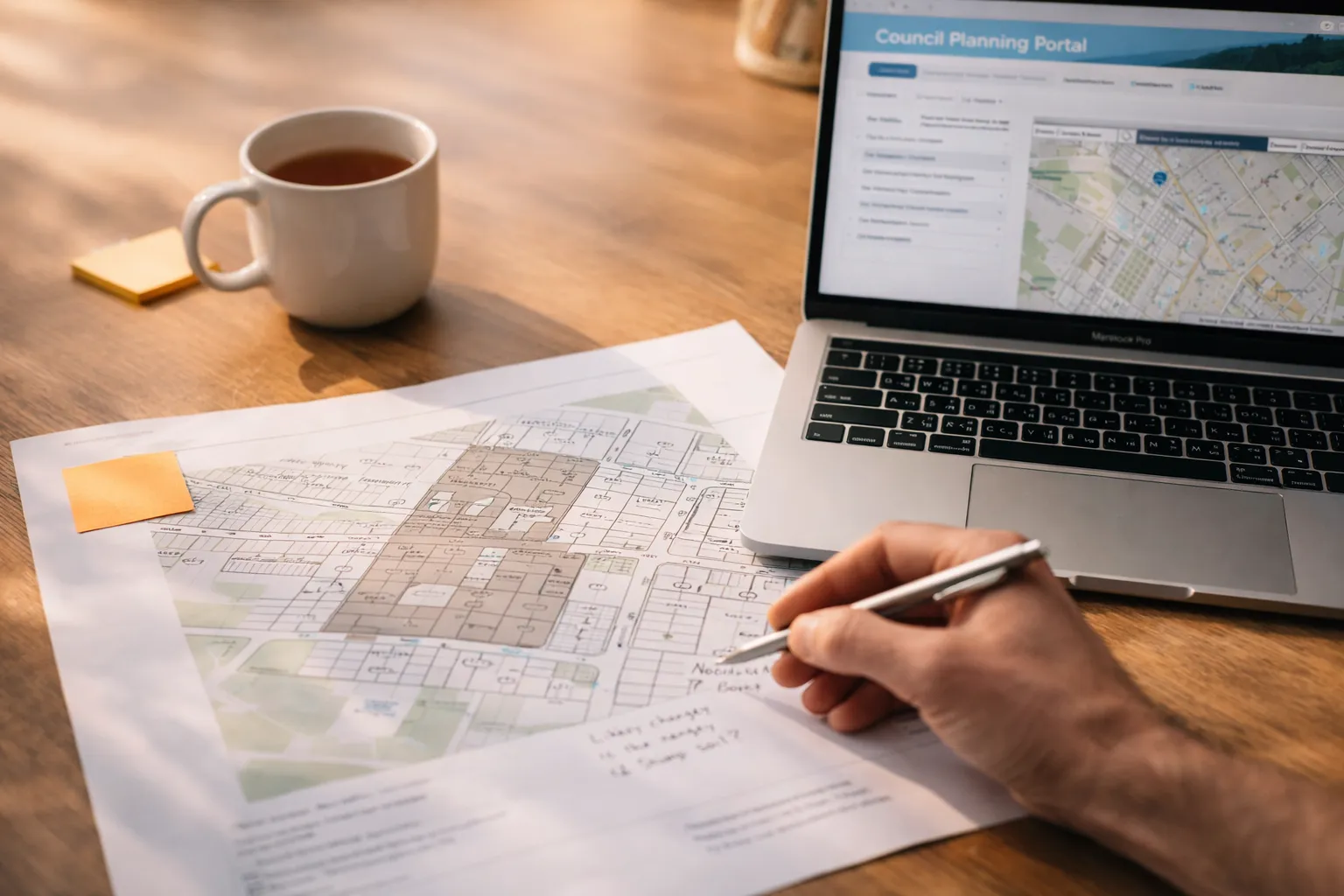
The most reliable approach:
- Look up your property’s zoning — use your state’s planning portal (e.g. NSW Planning Portal, VicPlan)
- Check for site constraints — flooding, bushfire, heritage overlays can affect what’s permitted
- Call your council’s planning enquiry line — ask specifically about tiny homes and get their position in writing
- Check the ATHA local laws tracker — the Australian Tiny House Association maintains council-by-council information
- Engage a town planner — for complex situations, a professional familiar with your council is worth the investment
The Regulatory Landscape Is Changing
The rules are evolving. Shellharbour City Council in NSW is running a pilot allowing mobile tiny homes without a DA. Surf Coast Shire in Victoria has a THOW trial program. Queensland’s proposed Distinctly Queensland Design Series could standardise secondary dwelling rules statewide. These are signs of a system gradually adapting to the growing demand for alternative housing.
The best time to check the rules is before you commit — and the best place to start is your state regulation guide.
Frequently Asked Questions
Can I put a tiny home in my backyard?
Yes, in most cases. If it’s a fixed structure (granny flat/secondary dwelling), you’ll need either complying development certification or a DA depending on your state and lot size. If it’s a THOW, NSW’s Clause 77 allows one caravan without approval if occupied by a household member. In QLD and VIC, check your council’s specific rules. Browse our regulation guides for your state.
Do I need council approval for a tiny home on my own land?
Not always. In NSW, a single THOW occupied by a household member on a property with an existing dwelling is exempt under Clause 77. A secondary dwelling under 60 sqm on a 450 sqm+ lot can go through the faster CDC pathway. But in most other scenarios — and in most other states — some form of approval is required. Start with your state’s regulation page.
Can I put a tiny home on rural land?
Generally yes, and rural land is often more flexible than residential land for tiny homes. Rural zoning typically allows dwelling houses, and councils in rural areas tend to be less restrictive about alternative housing. However, you still need to comply with building standards and may need to manage your own services (water, power, waste) if you’re off the grid. Our buying land guide covers what to check before purchasing, and our off-grid living guide explains the practicalities of going off-grid.
Can I put a tiny home on someone else’s property?
Yes — this is common. In NSW, Clause 77 specifically allows a household member to occupy a caravan on the property owner’s land. For a fixed secondary dwelling, the property owner would need to obtain the relevant approvals. You could also lease or licence land from a private landowner — our guide explains the legal differences and what to put in writing. Talk to the property owner’s council.
How close to the boundary can I put a tiny home?
Setback requirements vary by state and council. In NSW, complying development for secondary dwellings requires minimum distances from side and rear boundaries (typically 900mm). THOWs under Clause 77 don’t have specified setback requirements, but councils may apply general amenity standards. In VIC, ResCode standards specify setbacks based on wall height. Always check your specific council’s requirements.
Can I live in a tiny home while building my main house?
Yes — this is a common use case. Most councils will allow temporary occupation of a caravan or THOW while a primary dwelling is under construction, typically for the duration of the building permit (often 2–3 years). Some councils require a specific temporary accommodation permit. This is worth discussing with your council during the planning phase of your main build.