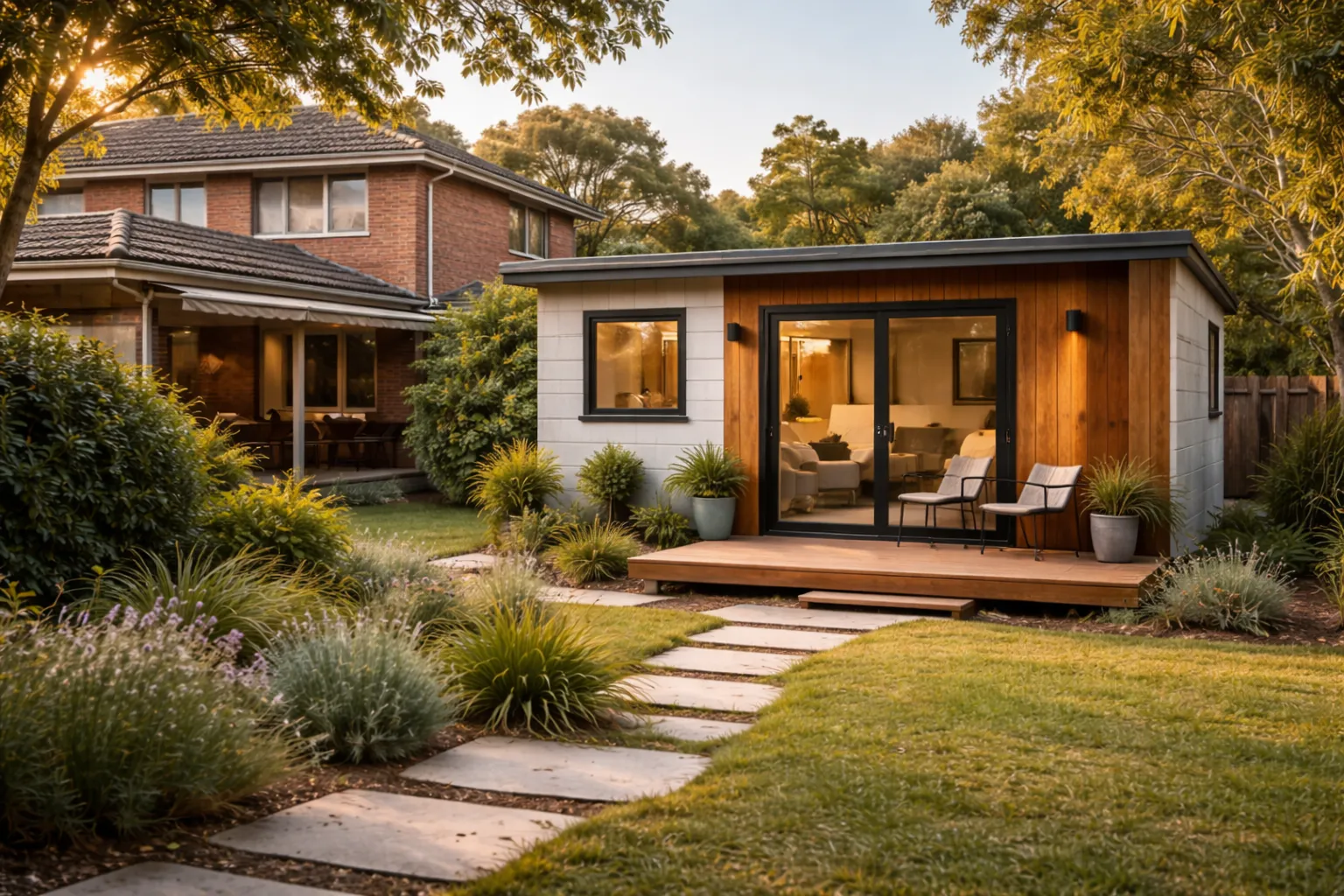
Rental Income from Your Own Land
A secondary dwelling can generate $250 to $500 per week in rental income, helping offset your mortgage or supplementing your household income.
Housing for Family Members
Keep ageing parents or adult children close by without sacrificing anyone's independence. A separate dwelling on the same property offers the best of both worlds.
Increased Property Value
A well-built secondary dwelling adds genuine value to your property. Dual-income properties are increasingly sought after by buyers.
Fast-Track Approval via CDC
In many states, secondary dwellings up to 60 square metres can be approved through a Complying Development Certificate — faster and cheaper than a full development application.
Lower Cost Than an Extension or Renovation
A tiny home secondary dwelling typically costs less than a major home renovation and delivers a self-contained, independent living space.
Why Tiny Homes Work as Secondary Dwellings
Adding a secondary dwelling to your property is one of the most practical ways to make better use of your land. Whether the goal is housing an elderly parent, providing a space for an adult child, or generating rental income, a tiny home can deliver a self-contained, high-quality living space at a fraction of the cost of a traditional granny flat build.
Unlike conventional granny flats, which are typically built on-site from scratch, many tiny home manufacturers deliver a pre-built or modular dwelling that can be craned into position and connected to services in a matter of weeks rather than months. For a detailed comparison, see our tiny home vs granny flat guide.
CDC vs DA: Understanding the Approval Pathway
In most Australian states, there are two main pathways to approval for a secondary dwelling. The specifics vary — check your state’s regulation guide for details.
Complying Development Certificate (CDC)
A CDC is a fast-track approval process for developments that meet a set of predetermined standards. In New South Wales, for example, the State Environmental Planning Policy (Exempt and Complying Development Codes) 2008 allows secondary dwellings of up to 60 square metres on lots that meet minimum size requirements. A CDC can be issued by an accredited certifier — often within 10 to 20 business days — without the need for a full council assessment.
To qualify for CDC in NSW, the secondary dwelling generally must:
- Be no more than 60 square metres in floor area
- Meet setback requirements (typically 900mm from side and rear boundaries)
- Comply with height limits (typically 3.8 metres for a flat roof, 5.4 metres for a pitched roof)
- Not be on land with certain environmental or heritage overlays
- Be on a lot zoned for residential use
Other states have similar fast-track mechanisms, though the terminology and specific requirements vary. In Victoria, for instance, a secondary dwelling may fall under the VicSmart pathway if it meets certain criteria.
Development Application (DA)
If your project does not meet CDC criteria — perhaps the lot is too small, the site has heritage constraints, or you want to exceed the size limit — you will need to lodge a development application with your local council. This process typically takes longer (eight to twelve weeks or more) and may involve neighbour notification, but it allows more flexibility in design and placement.
Setback Rules and Site Planning
Setback requirements dictate how far your secondary dwelling must be from property boundaries, the primary dwelling and other structures. These rules exist to ensure adequate privacy, natural light, ventilation and fire safety.
Common requirements include:
- Side and rear boundary setbacks of 900mm to 1.5 metres
- Minimum separation from the primary dwelling (often 3 metres, though this varies)
- Front setback requirements, which typically prevent a secondary dwelling from being placed in front of the main house
- Private open space provisions, ensuring both the primary and secondary dwelling have adequate outdoor areas
Your builder or a private certifier can assess your specific site and advise on what is achievable.
Connecting to Services
A secondary dwelling needs its own connections to water, sewer (or an on-site system), electricity and potentially gas. In urban areas, connecting to existing mains services is usually straightforward, though costs vary depending on the distance from your existing connection points.
Key considerations:
- Sewer connection — Sydney Water, for example, charges a fee for a new sewer connection and may require a Section 73 compliance certificate
- Electricity — a secondary dwelling may need its own meter or a sub-meter arrangement
- Stormwater — the dwelling and any associated hardstand must drain to an approved system
- Telecommunications — NBN connection is generally available if the primary dwelling is connected
Budget between $10,000 and $25,000 for service connections, depending on your site and location. Your builder should be able to provide a realistic estimate based on a site inspection.
Cost Comparison
A traditional on-site granny flat build in Australia typically costs between $120,000 and $200,000 or more, depending on size and finishes. A prefabricated or modular tiny home designed as a secondary dwelling can often be delivered and installed for $100,000 to $160,000, with the added advantage of a faster build timeline and less disruption to your property during construction.
The cost difference is largely driven by the efficiencies of factory construction — controlled environments, less waste, and no weather delays.
Rental Income Potential
If you intend to rent out your secondary dwelling, the income potential depends on your location. As a guide:
- Metropolitan areas — $300 to $500 per week for a well-appointed one-bedroom dwelling
- Regional centres — $200 to $350 per week
- Rural areas — $150 to $250 per week
Rental income from a secondary dwelling is assessable for tax purposes, but you can claim deductions for expenses including depreciation, insurance, maintenance and a proportion of council rates. A quantity surveyor can prepare a depreciation schedule to maximise your deductions.
Getting Started
Begin by checking your lot size, zoning and any overlays that might affect your eligibility for a secondary dwelling. If you do not yet own a property, our buying land guide explains what to look for when purchasing a block suited to a secondary dwelling. Your local council’s online planning tools are a good starting point, or you can engage a town planner or private certifier for a preliminary assessment. Once you know what is permissible, connect with a builder experienced in delivering tiny homes as secondary dwellings — they will understand the regulatory requirements and can guide you from design through to occupancy.
Find Granny Flat & Secondary Dwelling Builders
Find Builders